
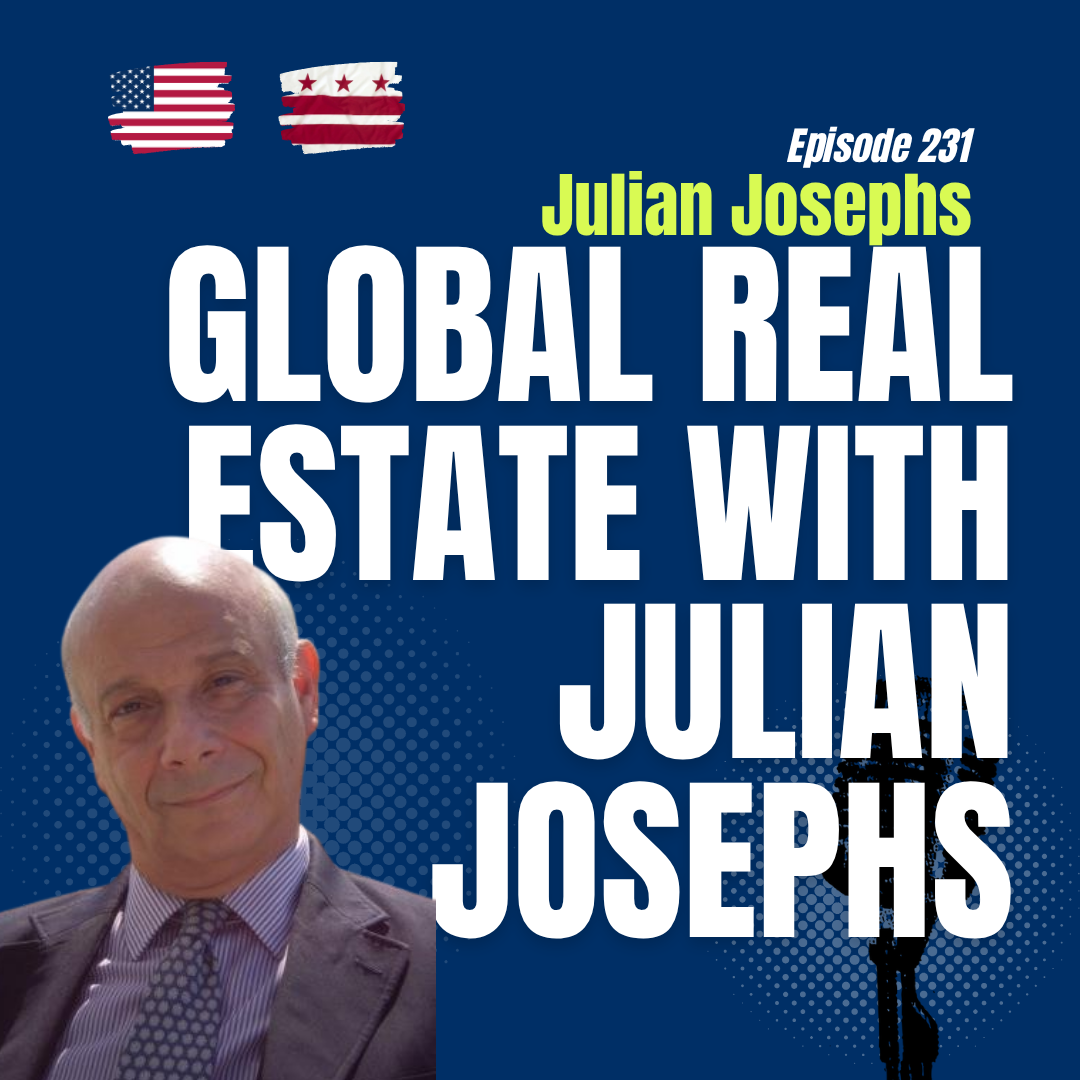
Mastering Global Real Estate Investing: Insights from the Crossroads of Capital with Julian Josephs
The landscape of global real estate has undergone a seismic shift over the last four decades. What was once a niche market for the most daring institutional players has transformed into a sophisticated, interconnected "global track" where cross-border transactions are now a matter of course. For the modern real estate investor and the ambitious real estate broker, success no longer depends solely on local knowledge, but on the ability to navigate complex international waters.
In this comprehensive guide, we draw on the career of Julian Josephs—President of Julian Josephs Company and Past World President of FIABCI—to explore the evolution of international capital flows, the critical importance of a global real estate directory, and the strategies that define a high-performing international portfolio.
Table of Contents
- The Evolution of Global Capital: From Old Europe to the New World
- The Risk-Reward Framework: Navigating Political and Tax Stability
- For Brokers: Leveraging a Real Estate Directory for Global Networking
- The First Rule of Global Assets: Why the Center Always Wins
- The $100 Million Mindset: Training the Next Generation
- The Future of the Industry: Technology and Social Responsibility
Watch the Full Interview with Julian Josephs

The Evolution of Global Capital: From Old Europe to the New World
Julian Josephs began his career at a time when "cross-border business was just starting off". Based in London and later moving to Paris and the United States, Josephs witnessed the initial wave of European capital seeking entry into the American market—a move that was considered pioneering at the time.
Today, the flow has matured and, in many ways, reversed. While the early days saw very little American money entering European markets like France, we now see a robust exchange where U.S. investors are dominant players in international hubs. This maturity means that today’s international real estate directory is more crowded than ever. To stand out, investors must understand that the "newness" of global investing has been replaced by a requirement for extreme precision and deep cultural understanding.
The Risk-Reward Framework: Navigating Political and Tax Stability
One of the most vital insights Josephs shares is the "get money in, get money out" philosophy. For any real estate investor looking at foreign geographies, the tax structure is the first hurdle. It is not enough to find a property with high yield potential; one must ensure that the income can be repatriated easily and that the host government will not impose restrictive conditions on capital in the future.
Key Considerations for Market Analysis:
- Political Stability: Changing governments can lead to radical shifts in investment policy. Boards and directors must remain "on the ball" to anticipate these changes.
- Legal Infrastructure: Working with top-tier legal advisors is non-negotiable to ensure that money is invested safely and remains liquid.
- Repatriation of Funds: Pension fund managers, in particular, prioritize the ability to receive income back into their home jurisdictions without friction.
Josephs notes that while there is no "rule of thumb" or universal methodology, the analysis of a country’s political stability and its conditions on foreign capital is the bedrock of any cross-border decision.
For Brokers: Leveraging a Real Estate Directory for Global Networking
For the real estate broker, the transition to global business requires a different set of tools. In a world saturated with digital information, the value of a trusted real estate directory cannot be overstated. However, Josephs emphasizes that a directory is only as good as the relationships it fosters.
Organizations like FIABCI (The International Real Estate Federation) act as a living commercial real estate directory, providing access to professionals in over 50 countries. For a broker, being part of such a network offers several advantages:
- Vetted Partners: When moving "other people's money" across borders, you need a business real estate directory of professionals who are held to high ethical standards.
- Face-to-Face Connection: Despite the rise of the internet, Josephs argues that transactions are still completed based on personality and trust. High-profile conferences like MIPIM in Cannes or ExpoReal in Munich serve as the physical manifestation of a global real estate directory, allowing for four days of fruitful, person-to-person networking.
- Expertise Exchange: These networks allow brokers from developed markets to share expertise with emerging markets, creating new opportunities for growth that wouldn't exist in isolation.
By utilizing a professional real estate directory to find the right contacts, brokers can bridge the gap between "knowing about" a market and "owning" a market.
The First Rule of Global Assets: Why the Center Always Wins
When Josephs managed investments for Dutch pension funds in Washington, D.C., he adhered to a classic but critical principle: location. His strategy centers on investing in the "center of real estate activity" rather than the outskirts.
While the outskirts might offer lower entry costs, the growth of properties around a central location provides a safety net and a higher probability of long-term appreciation. This is especially true for real estate investors looking at foreign cities where they may not have the same "boots on the ground" intuition as they do in their home markets. Sticking to the core districts identified in any reputable metropolitan real estate directory reduces the risk profile of the investment.
The $100 Million Mindset: Training the Next Generation
As an educator at Georgetown University and Johns Hopkins, Josephs uses a unique pedagogical approach to instill a global mindset in his students. He provides them with a hypothetical $100 million to invest in a mixed portfolio in a country of their choice.
The exercise is then reversed: the students must take $100 million from that foreign country and invest it back into the United States. This teaches them to look at the U.S. market through the eyes of an overseas investor. This "reverse perspective" is vital for any real estate broker or investor trying to understand why international capital behaves the way it does. It highlights that an online real estate directory search is just the start; understanding the *motivation* behind the capital is what closes deals.
The Future of the Industry: Technology and Social Responsibility
The future of global real estate is being shaped by two major forces: digitization and social impact. Josephs admits that the sheer amount of travel required in the early days has been mitigated by the internet, yet the need for "knowing the personalities" remains constant. Technology can help you find a partner in a real estate directory, but it cannot replace the confidence built through a face-to-face meeting.
Furthermore, the role of affordable housing is becoming increasingly central. As real estate leaders, Josephs believes it is incumbent upon the industry to expand low-cost housing initiatives. Through his work with the Global Housing Foundation, he emphasizes that even when it isn't the highest priority for a particular country, advancing the cause of affordable housing is a goal the global community must strive for.
Closing Thoughts
Global real estate is no longer just about transactions; it is about the mastery of a global network. Whether you are using a real estate directory to find your next partner or analyzing the political stability of a new market, the lessons from Julian Josephs' career remain clear: be "on the ball," prioritize the center of activity, and never underestimate the power of a personal handshake.
Connect with Julian Josephs:
For further insights or to reach out to Julian directly, please visit his official FIABCI profile: Julian Josephs Contact Information.
This article was created based on an interview with Julian Josephs, a global leader who oversaw the development of over $350 million in real estate.

 HalloCasa: “Good morning Mr. Burkart. Thank you very much for taking the time and to talk with us about your experience in Colombia. To initiate, why don´t you introduce yourself quickly?”

 HalloCasa: “Good evening Jonathan. Thank you very much for taking your time and talk with HalloCasa about the Colombian real estate market. Before digging into the topic itself, could you quickly introduce yourself and give us an overview of your background?”

 partner of