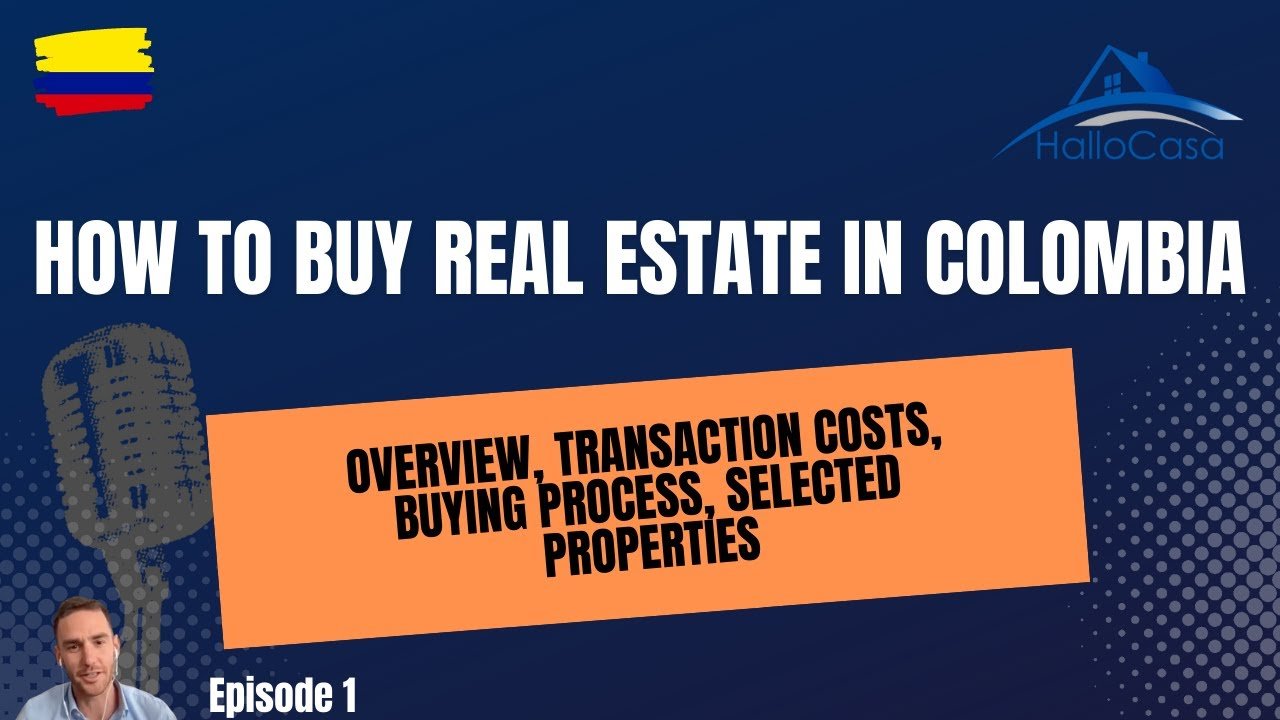
How to buy Real Estate in Colombia, Webinar #1
HalloCasa Webinar #1 explains how to buy real estate in Colombia: why to invest there, the buying process, financing, taxes and the legal points foreign buyers should know.
Episode overview
1.1 Why invest in Colombia real estate? 1.2 How stable is the political situation in Colombia? 2.1 How liquid is the Colombian real estate market? 2.2 How has the Colombian real estate market developed in recent years? 3.1 How much are the real estate transaction costs in Colombia (notary fee, taxes, register costs)? 3.2 Where can I find Colombian real estate financing? 4.1 Do I need to declare my rental income at the Colombian tax office (DIAN)? 4.2 Is there a limit of investments in quantity or price in Colombia? 4.3 What kinds of properties are foreigners allowed to buy in Colombia? 4.4 What immigration policies apply to foreigners in Colombia? In an emergency can I take my family? 4.5 Is there a reliable property manager on site in Colombia? 4.6 Can money be transferred from Colombia to my home country?
1.1 Why invest in Colombia? The CIA Report about Colombia states: “Colombia is in the midst of a demographic transition resulting from steady declines in its fertility, mortality, and population growth rates. The birth rate has fallen from more than 6 children per woman in the 1960s to just above replacement level today as a result of increased literacy, family planning services, and urbanization.”
2.1 How liquid is the market? This depends on the property you buy. Urban real estate tends to be sold easier than rural property. The real estate sales volume in Colombia in 2014 amounted to USD 9.72 billion and grew in 2014 by 4.5% Check out the National Administrative Statistics Office (Colombia) or the BBVA Real Estate Outlook 2015. in our Research section. 2.2 How has the Colombian real estate market developed in recent years? Within the last 10 years, the value of some properties in Colombia has doubled. Especially in Bogotá, property prices have risen. In regards to this topic read our interview with Mr. Edwin Schuh here. Additionally, you will find statistical documents in our Research section. 2.4 What is a ""social stratum""? In Colombia, areas and neighborhoods are separated into ""Estratos"" (social strata). The scale runs from 1 to 6, with 1 being the lowest and 6 being the highest. Estratos define the following things: Due to this classification the quality of life can vary significantly within one town. In our Research section you can find several links which redirect you to respective information.
3.2 Where can I find Colombian real estate financing? Since you're probably not a customer of a Colombian bank, you need to handle all the financial matters with your bank in your home country. If you have a Colombian identity card (""Cedula"") which, among other things, you get when you invest more than 210,000.00 US dollars, you can become a client of a Colombian bank. You can then make an appointment with your preferred bank. 4.1 Do I need to declare my rental income at the Colombian tax office (DIAN)? This depends on various aspects. The decree 2974 Article 6 can help you learn more about taxes. In addition, see the Research link to the tax office. For further information consult a professional accountant.
"

 This time, we interviewed Cesar Torres Garcia, Real Estate Sales Manager in Queretaro, El Bajio, Mexico, who will tell us about his experience and several important aspects related to the real estate market in Mexico.