Strategic Guide for Real Estate Investors in Slovenia: Market Dynamics, Legal Frameworks, and Cross-Border Investment Strategies
1. "Want to Know" Micro-Moment: Direct Answers for Real Estate Investors in Slovenia
The Essential Breakdown for Global Capital
Is investing in Slovenian real estate viable for foreign investors? Yes. Citizens of European Union (EU) and European Economic Area (EEA) member states can acquire property directly with identical rights to domestic buyers. Non-EU buyers operate under a statutory reciprocity regime (vzajemnost); where bilateral treaties are absent or complex, international capital routinely enters the market through a registered Slovenian limited liability company (družba z omejeno odgovornostjo / d.o.o.), which purchases real estate as a domestic entity.
What is Slovenia’s primary fiscal advantage? Unlike almost all OECD and EU member states, Slovenia levies no recurring annual property holding tax on real estate ownership. Once acquired, your cost of carrying vacant or appreciating property is negligible.
What is the primary operational bottleneck? The residential rental market is characterized by strict statutory tenant protections, where judicial eviction procedures often require 2 to 3 years to resolve. Combined with an effective 22.5% tax on net rental income, sophisticated real estate investors in Slovenia focus primarily on capital appreciation, multi-family value-add repositioning, and commercial logistics assets rather than traditional long-term buy-to-let housing.
How can cross-border buyers ensure transactional safety? By retaining certified professionals registered in the official real estate directory Slovenia, curated by the Slovenian Chamber of Commerce and Industry (GZS). Licensed local brokers carry mandatory liability insurance and adhere to statutory standards of dual representation.
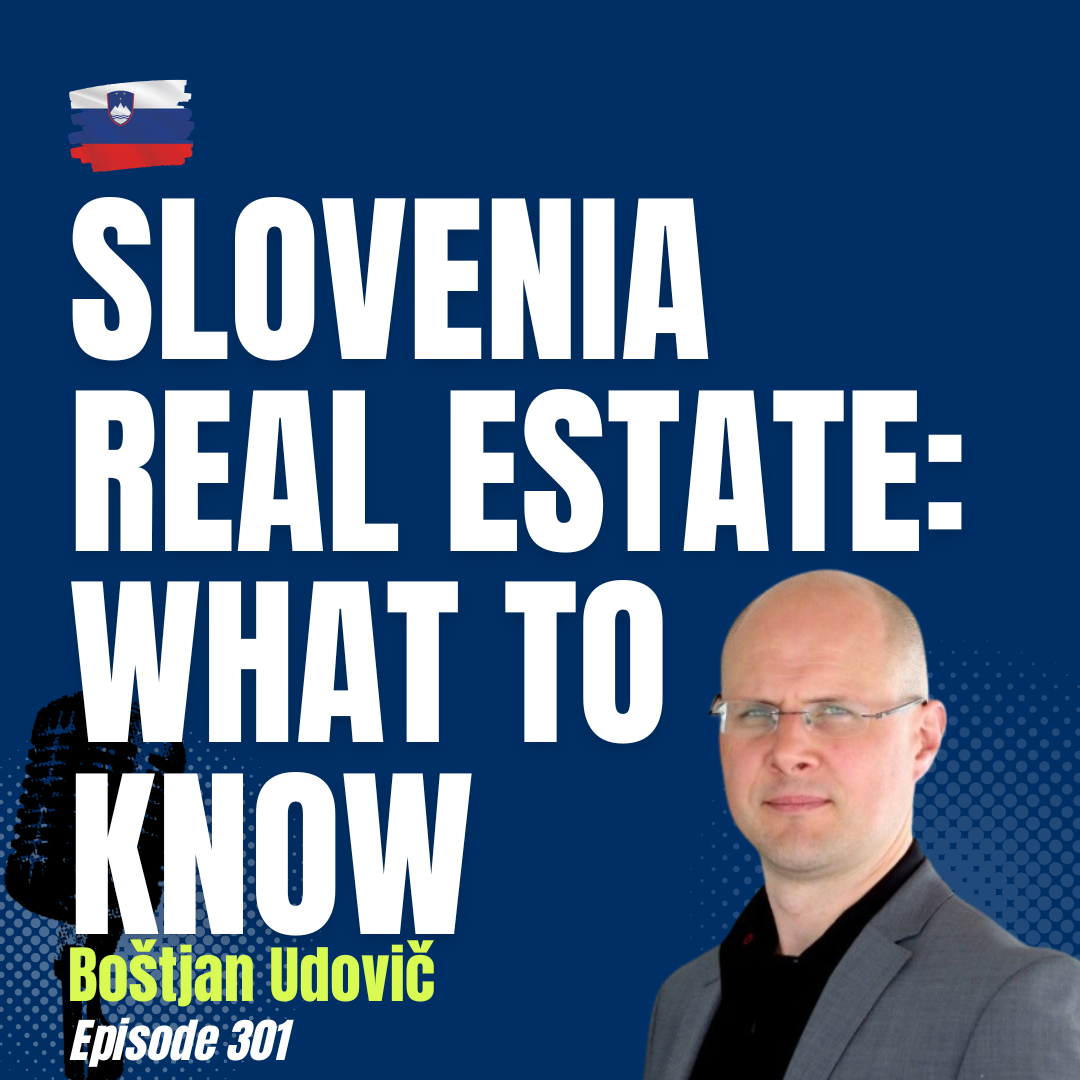
2. Video Briefing: Expert Podcast Interview with Boštjan Udovič
To grasp the micro-level nuances of property acquisitions, urban planning regulations, and transactional mechanics, review the complete podcast discussion between HalloCasa host Mike and Boštjan Udovič, legal expert and Managing Director of the Real Estate Association of Slovenia within the Chamber of Commerce and Industry of Slovenia (GZS).
Access the full recorded video directly on YouTube: Slovenia Real Estate: Market Trends, Property Buying & the Future with Boštjan Udovič (YouTube).
3. Macro Fundamentals: Why Central Europe and Slovenia Command Global Capital
Slovenia occupies an enviable geostrategic position at the convergence of Central Europe, the Mediterranean basin, and the Balkan trade routes. Bordering Italy, Austria, Hungary, and Croatia, this nation of approximately two million people provides international investors with a stable, highly developed European environment backed by the Eurozone and Schengen frameworks.
The Maritime Gateway: Port of Koper and European Logistics Corridors
Unlike landlocked Central European economies such as Austria, Hungary, the Czech Republic, or Slovakia, Slovenia commands direct sovereignty over the Adriatic coastline through the deep-water Port of Koper. Koper functions as the shortest, most cost-effective maritime freight corridor connecting Asian and Mediterranean shipping lanes directly to Central and Eastern European industrial powerhouses.
To handle expanding cargo volumes, Slovenia is completing major infrastructure projects, highlighted by the multibillion-euro construction of the second railway track linking Koper to the inland hub of Divača. This high-capacity transit corridor enhances intermodal freight throughput directly to Ljubljana and onwards to Vienna, Munich, and Budapest, transforming surrounding industrial submarkets into primary targets for commercial real estate developers.
High-Skilled Labor, Advanced R&D, and Quality of Life
Slovenia's real estate demand is reinforced by strong economic fundamentals. As Boštjan Udovič details in the interview, the domestic economy is anchored by high-value, research-intensive sectors including pharmaceuticals, advanced automotive components, clean technologies, and specialized IT engineering. Despite industry discussions surrounding corporate social contribution rates and income tax brackets, multinational enterprises continue to expand their physical footprints in Slovenia due to the country's multilingual, highly educated workforce, low crime rates, pristine alpine-Mediterranean environment, and excellent public infrastructure.
Key Macro Indicators for Real Estate Investors in Slovenia
- Prime Logistical Hub: The Port of Koper provides direct maritime access to Central Europe's top manufacturing clusters.
- Sovereign Infrastructure Modernization: The second railway track from Koper to Divača expands nationwide freight throughput and logistics land values.
- Economic Resilience: Anchored by institutional industrial leaders in biopharmaceuticals, robotics, and advanced engineering.
- Exceptional Security & Livability: Consistently ranked among the safest and most environmentally pristine countries in the world.
4. Legal Blueprint for Real Estate Investors in Slovenia: Direct Acquisition vs. Corporate SPV
Before allocating capital, international buyers must navigate the distinct legal layers that govern property ownership in the Republic of Slovenia, established by Article 68 of the Constitution and detailed real property statutes.
EU/EEA Citizens vs. Non-EU Buyers: The Principle of Reciprocity
The regulatory framework divides foreign buyers into two principal categories:
- EU, EEA, and OECD Nationals: Citizens of European Union member states, the European Economic Area, and qualifying bilateral treaty jurisdictions acquire real estate under identical statutory conditions to Slovenian citizens. No special ministerial approvals, administrative clearances, or prior domestic residence permits are required to enter title in the Slovenian Land Registry (Zemljiška knjiga).
- Non-EU / Third-Country Individuals: Individuals from non-EU jurisdictions face statutory reciprocity tests (vzajemnost). Under this framework, a foreign physical person may only acquire title if Slovenian citizens are granted equivalent, unhindered real estate ownership rights under the legal codes of the buyer's home country. The Ministry of Justice evaluates each case against its official reciprocity registry before an individual title entry can be executed.
The Corporate Solution: Utilizing a Slovenian Special Purpose Vehicle (d.o.o.)
Because determining bilateral individual reciprocity can involve protracted administrative verifications, institutional funds and private real estate investors in Slovenia from third-party nations consistently utilize corporate acquisition structures. By establishing a local Slovenian limited liability company (družba z omejeno odgovornostjo / d.o.o.), the investor creates an autonomous Slovenian legal entity.
Under Slovenian corporate and property law, a domestic d.o.o. holds full legal rights to acquire residential, commercial, industrial, or agricultural land across Slovenia, regardless of the nationality of the company's ultimate beneficial owners or corporate shareholders. Forming a d.o.o. requires a statutory minimum share capital of €7,500, a registered business address, and standard corporate filings, offering a predictable, fully compliant acquisition vehicle for international family offices.
Due Diligence Roadmap for Acquiring Slovenian Property
- Select an Accredited Advisory Team: Consult the verified real estate directory Slovenia maintained by the GZS to retain licensed, insured brokers and legal counsel.
- Audit Title via the Electronic Land Registry: Confirm clean ownership, verify existing mortgages or easements, and identify municipal pre-emption rights (predkupna pravica).
- Confirm Zoning and Building Permissions: Review municipal spatial plans (občinski prostorski načrt / OPN) to ensure existing improvements possess valid building and occupancy permits (gradbeno in uporabno dovoljenje).
- Structure Transactional Escrow: Execute the purchase contract through a licensed Slovenian notary public (notar) utilizing secure custodial escrow accounts for fund disbursement.
5. Fiscal Architecture: The 0% Property Tax Advantage vs. Rental Market Yield Realities
The fiscal environment for real estate investors in Slovenia features a unique dynamic: an exceptionally lenient holding-tax environment contrasted against rigorous taxation on operational rental revenue.
The 0% Annual Real Estate Property Tax Phenomenon
Contrary to common practice across North America and Western Europe, Slovenia does not levy a recurring, ad-valorem annual property holding tax on real estate. While municipal fees for the use of building ground (nadomestilo za uporabo stavbnega zemljišča / NUSZ) exist, these local maintenance contributions represent negligible fractions of an asset's market value.
As Udovič explains, despite repeated recommendations from international monetary bodies and the OECD urging successive governments to introduce a broad-based property tax, legislative action has consistently stalled. The fundamental driver is sociological: approximately 80% to 85% of Slovenian households own their primary residence. This widespread homeownership stems from the early 1990s privatization (the "Jazbinšek Law"), which allowed citizens to acquire former public and socially-owned apartments at nominal valuations. Imposing an annual property tax therefore remains politically sensitive. For international equity holders, this fiscal landscape enables long-term capital preservation with virtually zero carrying tax friction.
Transactional Taxation: Acquisition, Disposal, and Capital Gains
Investors must plan for transaction-based levies when acquiring or divesting real estate:
- Real Estate Transfer Tax (DPN): A standard 2% transaction tax levied on the purchase price or appraised market value of secondary/existing property transfers (new developments subject to Value Added Tax are exempt from DPN).
- Capital Gains Tax (Dobiček iz kapitala): Realized net profits from the sale of real estate are taxed at a base rate of 25%. To incentivize long-term ownership and deter rapid flipping, this rate scales downward across five-year holding thresholds (reducing to 20% after 5 years, 15% after 10 years, and tapering to 0% after prolonged holding periods).
The Operational Reality: Calculating Net Rental Returns
While holding land or vacant units carries minimal tax overhead, generating recurring cash flow through residential leasing requires careful fiscal planning:
| Fiscal Category | Statutory Rate | Effective Operational Rate | Strategic Impact on Investors |
|---|---|---|---|
| Annual Holding Tax | 0.00% | 0.00% (Minimal municipal NUSZ fees) | Exceptional environment for long-term equity compounding and land banking. |
| Transfer Tax (DPN) | 2.00% | 2.00% | Low transaction friction compared to Western European closing costs. |
| Rental Income Tax | 25.00% | 22.50% (after standard 10% normalized expense deduction) | Substantial drag on net yields from traditional residential buy-to-let models. |
| Capital Gains Tax | 25.00% base rate | Scales downward every 5 years toward 0% | Strongly rewards patient, long-term capital preservation horizons. |
Residential rental revenue is taxed at a flat rate of 25%, offset by an automatic 10% statutory expense deduction, yielding an effective net tax rate of 22.5%. When combined with long eviction timeframes, many high-net-worth domestic and international owners prefer to leave premium residential properties vacant, banking solely on structural capital appreciation rather than active tenant management.
6. Valuation Trends: Prime Ljubljana Appreciation vs. High-Growth Regional Markets
Slovenia's property market exhibits distinct pricing tiers between its metropolitan core, prime lifestyle destinations, and emerging regional logistics corridors.
Ljubljana: Capital City Supply Constraints and Sustained Value Growth
The capital city of Ljubljana serves as the commercial, financial, educational, and political heart of the nation. Over the last 15 years, residential property values across the metropolitan area have surged between 100% and 150%, driven by chronic supply shortages, land zoning limitations, and strong domestic purchasing power.
Representative market pricing benchmarks across Ljubljana include:
- Average Secondary Housing Stock: Functional, existing multi-family apartments across established residential boroughs trade between €5,000 and €6,000 per square meter.
- Prime / New Luxury Developments: Prime, newly completed residential schemes featuring modern energy ratings and underground parking command up to €10,000 per square meter.
- Unrenovated Core Assets: Outdated housing units in older post-war concrete or pre-war architectural buildings rarely trade below €4,000 per square meter within central districts.
Regional Price Discrepancies: Coastal, Alpine, and Secondary Industrial Markets
Outside of central Ljubljana, pricing dynamics diverge significantly depending on economic drivers and geography:
- Coastal Belt (Koper, Izola, Piran, Portorož): Benefiting from maritime port operations, university campuses, and year-round tourism, prime coastal properties command pricing approaching Ljubljana levels, typically between €4,000 and €5,500 per square meter.
- Alpine Lifestyle Hubs (Bled, Bohinj, Kranjska Gora): Strict environmental preservation standards limit new construction, pushing prime alpine chalets and luxury flats into top pricing tiers.
- Secondary Industrial Centers (Celje, Maribor, Novo Mesto): Secondary hubs situated within a 45- to 75-minute drive of the capital offer attractive entry pricing, with quality existing residential assets trading from €1,500 to €2,500 per square meter, delivering comparatively higher gross yields for yield-focused investors.
The "Renovation Alpha": Repositioning Older Multi-Family Housing
Because widespread homeownership originated from the rapid privatization of public housing in 1991–1992, condominium buildings across Slovenian cities frequently feature fragmented private ownership, where 80% to 90% of occupants are individual owner-occupiers. In many older buildings, aging residents historically deferred collective capital contributions toward building upgrades, roof replacements, and facade insulation.
For value-add real estate investors in Slovenia, this structural dynamic creates an attractive niche. Acquiring unrenovated apartments at a discount, executing modern interior renovations, and upgrading thermal efficiency can unlock value increases of 20% to 50% upon resale, catering directly to affluent young professionals seeking turn-key homes in established urban cores.
7. Strategic Intelligence for Global Real Estate Agents: Dual Agency and Fee Deregulation
For international property consultants, private wealth advisors, and real estate brokerages orchestrating cross-border referrals into Europe, understanding Slovenia's specialized regulatory environment is essential for successful collaboration.
Topic 1: Statutory Dual Representation and Mandatory Broker Liability Insurance
In contrast to common-law jurisdictions where single-agent buyer representation is standard, the Slovenian property sector operates under continental civil law traditions centered on dual representation. Under Slovenian statute, a licensed real estate broker is legally bound to act as an impartial intermediary, safeguarding the legitimate economic and legal interests of both the vendor and the purchaser.
Crucially for international clients, the law mandates that all licensed brokerage firms maintain compulsory professional liability insurance. This statutory coverage shields international buyers and participating referral agents against losses arising from contractual negligence, land title verification errors, or undisclosed technical defects. When introducing international capital, overseas brokers should always confirm their local partner's active listing within the certified real estate directory Slovenia.
Topic 2: Landmark Abolition of Commission Caps and Strategic Partnership with the US NAR
The Slovenian real estate brokerage landscape has undergone major structural modernizations that align the market with international commercial standards:
- Constitutional Court Annulment of Commission Caps: For years, Slovenia remained one of the few European jurisdictions with a strict statutory 4% cap on real estate brokerage commissions embedded in national law. Following a prolonged legal initiative spearheaded by the Real Estate Association of Slovenia under Boštjan Udovič's leadership, the Constitutional Court formally struck down the statutory commission limit. This landmark ruling liberalized brokerage advisory fees, enabling specialized boutique agencies to provide bespoke, premium services for complex cross-border acquisitions and institutional mandates.
- Bilateral Alliance with the National Association of Realtors (NAR): Demonstrating its global integration, the Real Estate Association of Slovenia signed an official bilateral cooperation agreement with the US-based National Association of Realtors (NAR). This strategic alliance integrates international best practices, standardized ethical codes, and seamless global referral capabilities into the Slovenian brokerage ecosystem, making it easier for American, European, and worldwide brokers to transact with confidence in Slovenia.
Broker Due Diligence Verification Checklist
When structuring European deals, international buyer agents should verify that their local Slovenian partner holds an active broker license registered with the Ministry of the Environment, Climate and Energy, and operates within the Chamber of Commerce framework.
8. Mitigating Cross-Border Risk via a Verified Real Estate Directory Slovenia
Given the intricacies of foreign reciprocity, fragmented multi-family HOAs, and local zoning laws, navigating the market through unvetted classifieds or informal listing portals introduces unnecessary operational risk. Utilizing a verified real estate directory Slovenia is essential for professional due diligence.
1. Direct Verification of Chamber of Commerce (GZS) Accreditation
The definitive real estate directory Slovenia is maintained under the auspices of the Real Estate Association at the Chamber of Commerce and Industry of Slovenia (GZS). Member brokerages, certified building managers, and valuation experts within this directory are formally vetted, fulfill continuing legal education mandates, and operate under uniform industry codes of ethics.
2. Access to Multilingual Experts Experienced in Corporate Formations
Navigating the acquisition process via a recognized Slovenian real estate directory allows non-EU investors to connect directly with specialized agencies equipped to handle d.o.o. formations, coordinate corporate bank accounts, and liaise with public notaries. Leading international franchise networks such as Century 21 and RE/MAX, alongside respected independent boutique brokerages, feature dedicated English-, German-, and Italian-speaking desks experienced in cross-border transactions.
3. Sourcing Off-Market Commercial, Brownfield, and Public Sector Collaborations
An authoritative Chamber of Commerce real estate directory Slovenia provides exposure to opportunities that rarely appear on public consumer listing sites. These include off-market industrial warehousing, development land parcels near Koper and Divača, and joint-venture opportunities alongside private real estate funds and municipal housing authorities.
Key Advantages of Utilizing the Official Real Estate Directory Slovenia
- Guaranteed Insurance Underwriting: Confirmation that agency partners maintain active statutory liability coverage.
- Regulatory & Legal Competence: Up-to-date guidance on corporate SPV structuring and electronic Land Registry filings.
- Transparent Price Discovery: Reliable valuation guidance comparing prime Ljubljana metrics with high-growth regional logistics hubs.
9. Real Estate Investors in Slovenia FAQ: Legalities, Taxes, and Practical Operations
Can foreign nationals buy real estate directly in Slovenia as private individuals?
Citizens of EU and EEA member states enjoy full national treatment and can purchase real estate directly without special permits. For non-EU citizens, individual ownership depends on formal bilateral reciprocity (vzajemnost) confirmed by the Ministry of Justice. Non-EU investors routinely navigate this requirement by establishing a Slovenian limited liability company (d.o.o.), which purchases property as a domestic corporate entity without foreign ownership restrictions.
Does Slovenia have an annual property tax for real estate owners?
No. Slovenia does not levy a recurring annual ad-valorem property holding tax. Owners pay only modest municipal fees for the use of building ground (NUSZ), making the market particularly attractive for long-term equity preservation and capital growth strategies.
What are the primary taxes due when acquiring or selling property?
Secondary property acquisitions are subject to a 2% Real Estate Transfer Tax (DPN), typically paid by the vendor or allocated by contract. Profits on resale are subject to a 25% capital gains tax base rate, which systematically decreases across 5-year holding intervals, eventually dropping to 0% for long-term owners.
Why is the residential rental market in Slovenia considered challenging for landlords?
The private residential rental sector faces an effective 22.5% tax on net rental revenue (25% tax less a standard 10% expense deduction) alongside strong statutory tenant protections. Contested judicial eviction proceedings typically take 2 to 3 years to resolve in local courts. As a result, many property owners prioritize long-term asset appreciation over traditional residential renting.
What are the benchmark property prices per square meter in Ljubljana?
In central Ljubljana, existing residential apartments typically trade between €5,000 and €6,000 per square meter. Prime, luxury new construction projects command up to €10,000 per square meter, while unrenovated units in established neighborhoods rarely sell below €4,000 per square meter. Outside major urban centers, secondary regional towns offer entry valuations starting from €1,500 per square meter.
How does Slovenian law safeguard foreign buyers during transactions?
Slovenian real estate legislation requires licensed brokers to practice dual representation, impartially protecting the legitimate interests of both buyer and seller. Additionally, all licensed brokers are legally required to maintain professional liability insurance to indemnify clients against errors, legal oversights, or title verification faults.
Where can international investors access the official real estate directory Slovenia?
Investors can access the official real estate directory Slovenia through the Real Estate Association at the Chamber of Commerce and Industry of Slovenia (GZS), which maintains the comprehensive registry of accredited brokerages, property managers, and valuation experts.
10. Verified Professional Contacts & Official GZS Directory Access
International capital allocators, family offices, and foreign real estate brokerages seeking institutional market orientation, legislative guidance, or direct referrals to licensed Slovenian brokers are encouraged to connect directly with the national industry leadership:
Boštjan Udovič
Director of the Real Estate Association of Slovenia (Zbornica za poslovanje z nepremičninami)
Institutional Representation: Chamber of Commerce and Industry of Slovenia (Gospodarska zbornica Slovenije - GZS)
Professional Expertise: Real estate law, public housing policy, municipal zoning frameworks, and national real estate market regulation.
Official Chamber Portal: Gospodarska zbornica Slovenije (GZS Official Portal)
Professional LinkedIn Profile: Boštjan Udovič on LinkedIn (/bo%c5%a1tjan-udovi%c4%8d-b007ab83)
Through the central GZS portal, international investors and global real estate agents can access the accredited real estate directory Slovenia, verifying licensed brokers, registered property managers, and certified valuation experts across all Slovenian municipalities.